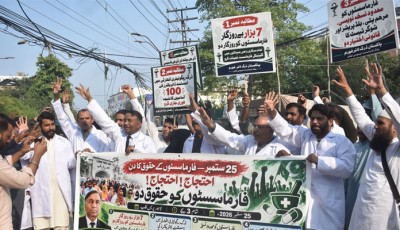

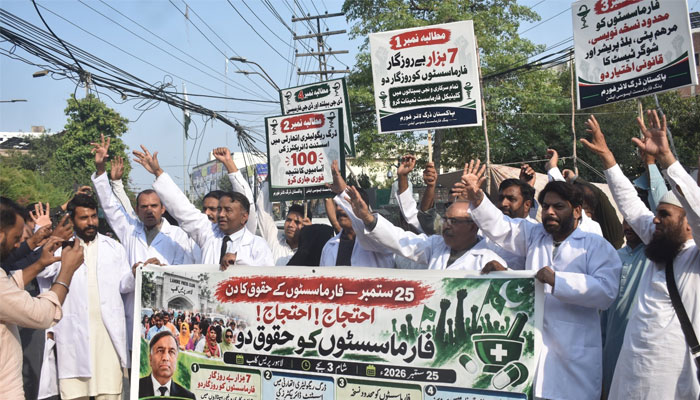
LAHORE: Pharmacists from across Punjab and other parts of the country staged a protest outside the Lahore Press Club on World Pharmacists Day, demanding employment opportunities, recognition of their professional role in healthcare, appointment of clinical pharmacists in hospitals and immediate announcement of results for more than 100 Assistant Director positions at the Drug Regulatory Authority of Pakistan (DRAP).
Pharmacists, representatives of professional bodies and members of various organisations participated in the demonstration, carrying placards and banners and raising slogans in support of their demands.
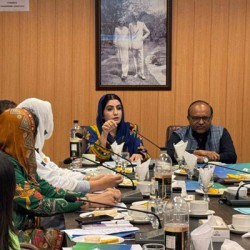
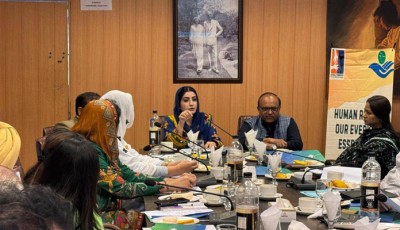
Addressing the gathering, pharmacy expert, pharmacist, Advocate High Court and President of the Pakistan Drug Lawyers Forum Noor Muhammad Mahar said pharmacists were an essential component of the healthcare system and played a significant role in ensuring the safe and appropriate use of medicines.
He said thousands of trained pharmacists remained unemployed despite a need for their services in hospitals, Basic Health Units (BHUs), medicine-monitoring systems and patient counselling services.
Mahar called upon the federal and provincial governments to create employment opportunities for approximately 7,000 unemployed pharmacists and make the appointment of clinical and hospital pharmacists mandatory in public and private hospitals.
He also demanded the immediate announcement of results for more than 100 Assistant Director positions at DRAP. According to him, recruitment examinations had been postponed or cancelled twice, while nearly two and a half months had passed since the third examination without announcement of the results.
He urged authorities to complete the recruitment process on merit and with transparency and fill other vacant technical positions to strengthen medicine regulation and public-health systems.
The protesters demanded appointment of at least one clinical or hospital pharmacist for every 10 hospital beds in public and private healthcare facilities. They also called for the permanent appointment of at least one pharmacist at every BHU in Punjab and other provinces.
Speakers at the demonstration said clinical pharmacists played an important role internationally in pharmaceutical care, dosage optimisation, monitoring adverse drug reactions, identifying drug interactions and reviewing patients' medication therapy.
The Pakistan Drug Lawyers Forum president also called for pharmacists to be legally authorised, under clearly defined regulations and approved standard operating procedures, to provide specified basic pharmacy services, including blood-pressure and blood-glucose testing, first aid and limited wound care at pharmacies.
He sought clear regulations allowing pharmacists to possess and use professional equipment such as blood-pressure monitors, glucometers and stethoscopes for authorised services.
Mahar said pharmacists' professional scope concerning over-the-counter medicines, approved essential and emergency medicines and vaccines should be clearly defined under the law and patient-safety standards.
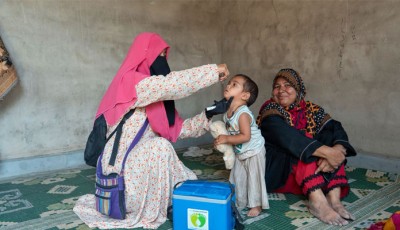
He proposed that pharmacists be formally assigned roles in vaccine storage, cold-chain management, dispensing and patient counselling, as well as vaccine administration where appropriate training and legal authorisation were in place.
He further called for consideration of limited prescribing authority for pharmacists only under a regulated framework involving formal training, a defined list of medicines, patient-referral mechanisms and approved standard operating procedures.
Mahar urged the Punjab Healthcare Commission and other relevant institutions to consider recommendations submitted by pharmacists and called upon Pharmacy Councils to formulate comprehensive terms of reference and professional protocols.
At the same time, he stressed that prescription-only medicines, including antibiotics, should be supplied strictly in accordance with applicable laws and against valid prescriptions.
He said expanding pharmacists' lawful professional scope should be aimed at providing patients with regulated, scientifically based and safe pharmaceutical care rather than encouraging irresponsible use of medicines.
The protesters also sought progress on the proposed Pharmacy Act 2026 framework, including clearly defined professional rights and responsibilities for pharmacists. They called for the role of registered Category-B personnel to be regulated through appropriate laws, training and professional supervision.
Mahar said pharmacists should have a formally recognised role in medication reviews to identify possible prescription errors, inappropriate dosages and potentially dangerous drug interactions and to communicate patient-safety concerns to medical practitioners through an appropriate monitoring mechanism. Any change to a prescription, he added, should be made in consultation with the relevant medical practitioner and under approved legal procedures.
“A pharmacist is not merely a person who sells medicine, but a scientific and protective bridge between the patient, the medicine and the medical practitioner,” Mahar told the gathering.
The protesters appealed to the Prime Minister, federal and provincial governments, Ministry of National Health Services, DRAP, Pharmacy Council of Pakistan, provincial pharmacy councils and Punjab Healthcare Commission to take action on their demands.
Pharmacists' organisations warned that if the government did not demonstrate progress, provide a practical action plan and issue a time-bound written assurance within approximately one month, they would launch the next phase of their protest movement across the country.
The participants concluded the demonstration by reaffirming their commitment to a peaceful and lawful campaign for patient safety, responsible use of medicines, employment opportunities and recognition of pharmacists' professional rights.